 Car insurance
 Telematics
 Van insurance
 Home insurance

 Car finance




Car insurance guides
What is black box or telematics insurance?
Learn what black box or telematics insurance is, how it works, whether it can lower your costs, and if it's worth it for drivers in the UK.
After analysing over 10 million car journeys, our data shows improvements in braking can make drivers safer on the roads.
Data analysis from drivers who use Marshmallow Move telematics has revealed a widespread opportunity to improve braking habits.
The analysis looked at data from over 10 million car journeys. Different behaviours were then scored out of 100 and grouped into six ratings: Dangerous, Very Poor, Poor, Average, Good, and Excellent.
Key findings
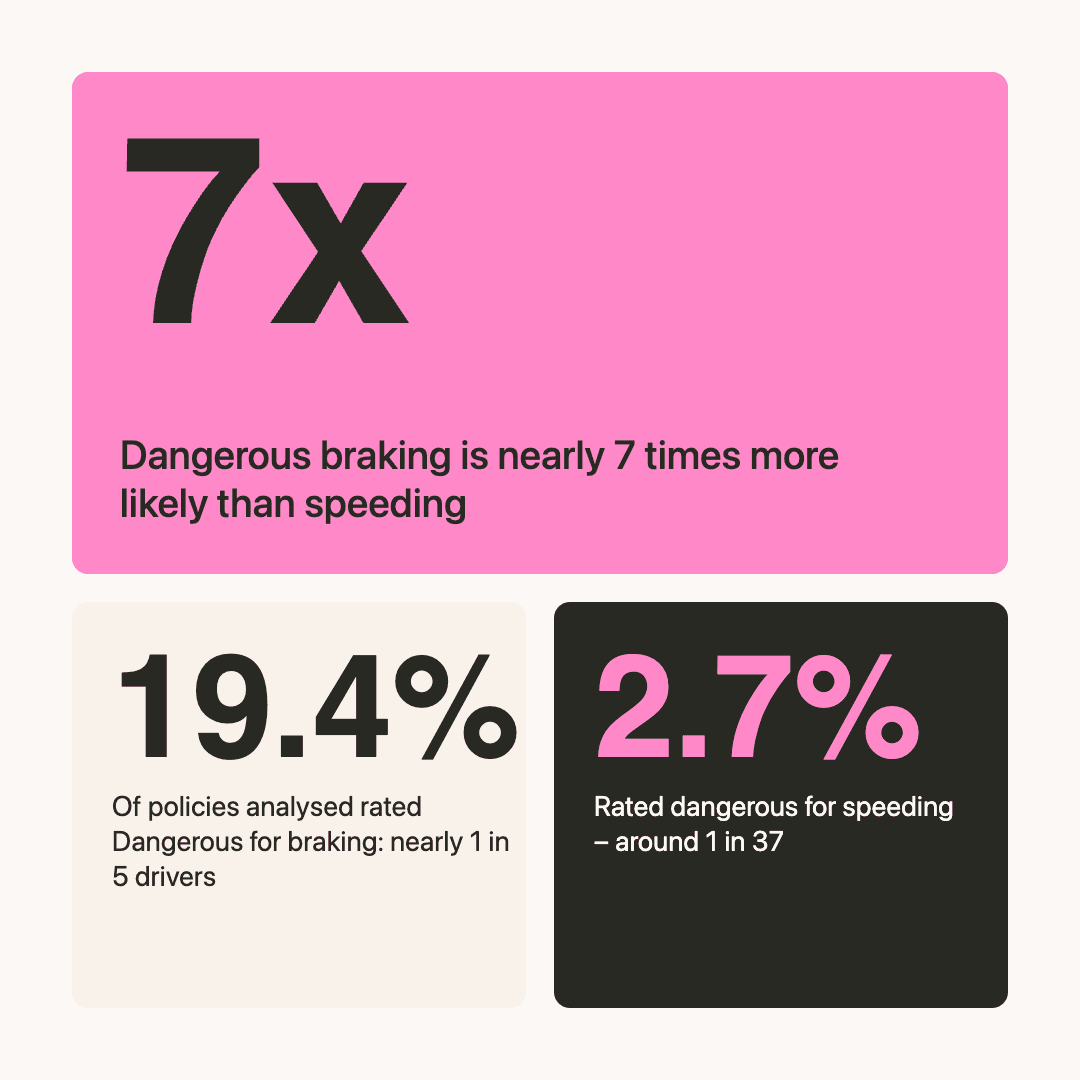
Braking was the biggest area for improvement, scoring worse than the other analysed areas of speeding, acceleration, cornering and phone use while driving.
How braking compares:
The data analysis looks at 5 areas of driving behaviour, with every journey getting a score out of 100 for each behaviour.
| Driving behaviour | % who scored ‘Poor’ or worse | % who scored "Dangerous" | |
|---|---|---|---|
| Braking | 51% | 19% | |
| Phone Handling | 33% | 9% | |
| Cornering | 23% | 4% | |
| Speeding | 15% | 2.7% | |
| Acceleration | 13% | 1.5% |
A sudden stop can be the right response to an unexpected hazard. But braking habits can also reveal how well we anticipate what is happening ahead.
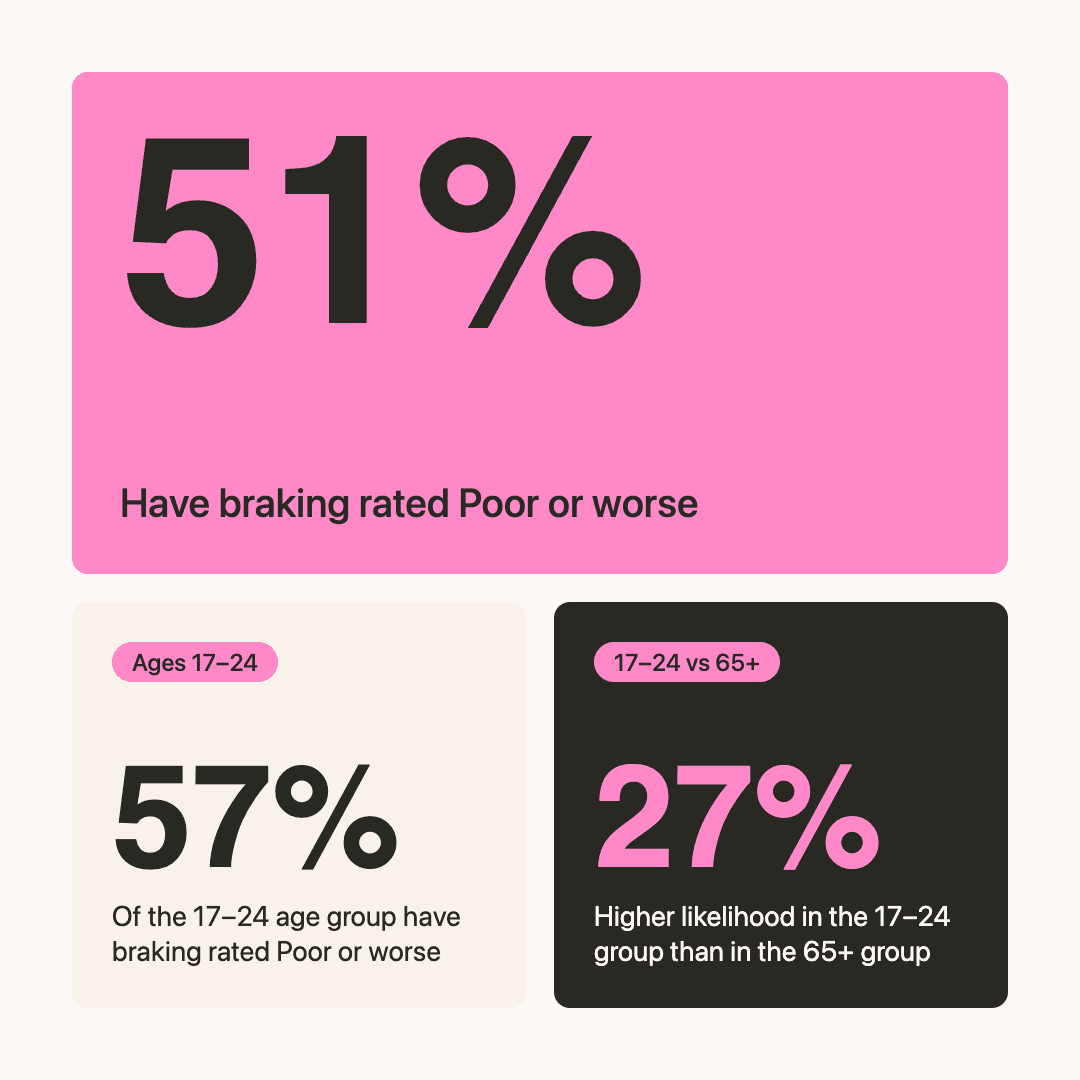
Our analysis found that 51% of policies had braking rated Poor or worse. That makes braking a useful starting point for a conversation about everyday driving habits.
“Harsh braking can be a sign that a driver or rider has responded late to a situation or event,” said Dr Leanne Savigar-Shaw, Associate Professor in Policing, Institute of Policing and Justice, University of Staffordshire.
A braking rating is a telematics classification. It is not a count of crashes, a finding that someone has broken the law, or a judgement about every journey they make.
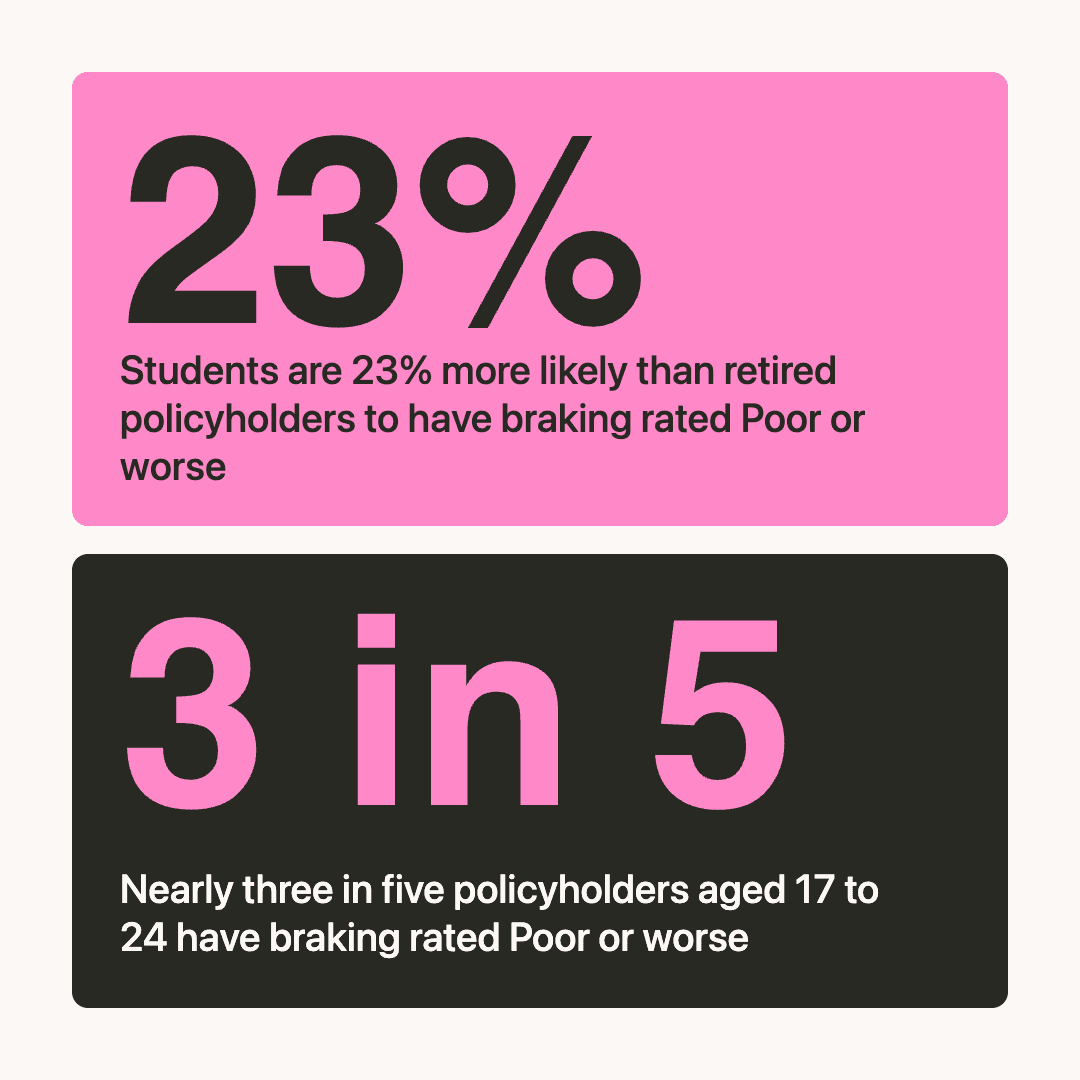
The data shows that young people are more likely to get a Poor or worse score for braking. These scores improve with age, although braking is the worst performing area across all age groups.
Age is the policyholder’s age and may differ from the age of the person driving. These comparisons have not been adjusted for vehicle, occupation, road conditions, or other factors.
| Policyholder age | Braking | Phone usage | Cornering | Speeding | Acceleration | |
|---|---|---|---|---|---|---|
| 17–24 | 57% | 39% | 39% | 19% | 19% | |
| 25–34 | 53% | 33% | 26% | 16% | 13% | |
| 35–49 | 48% | 32% | 18% | 13% | 11% | |
| 50–64 | 46% | 27% | 14% | 12% | 12% | |
| 65+ | 45% | 17% | 9% | 9% | 17% |
Among the 10 most common makes analysed, BMW drivers had the highest proportion of Poor-or-worse braking ratings (55%)
These were followed by Audi (54%) and Vauxhall (53%).
BMW drivers are 13.4% more likely than Mazda drivers to have braking rated Poor or worse (55% versus 46.6%).
Among the 10 most common car manufacturers in the sample of 100 cars, BMW has the highest proportion of Poor-or-worse braking ratings, followed by Audi and Vauxhall.
Toyota has the lowest proportion in this group. BMW’s proportion is approximately 14% higher than Toyota’s: 55% compared with 48%.
These are comparisons between policy groups, not evidence that a car make causes a particular braking habit. The ranking covers the 10 most common makes analysed.
| Car make | Braking | Phone usage | Cornering | Speeding | Acceleration | |
|---|---|---|---|---|---|---|
| BMW | 55% | 40% | 30% | 20% | 26% | |
| Audi | 54% | 39% | 30% | 21% | 26% | |
| Vauxhall | 53% | 31% | 25% | 15% | 9% | |
| Ford | 52% | 32% | 27% | 15% | 10% | |
| Nissan | 52% | 31% | 17% | 12% | 9% | |
| Honda | 51% | 28% | 23% | 10% | 7% | |
| Volkswagen | 50% | 35% | 26% | 14% | 18% | |
| Mercedes-Benz | 50% | 39% | 21% | 19% | 21% | |
| Hyundai | 49% | 32% | 20% | 12% | 10% | |
| Toyota | 48% | 29% | 16% | 11% | 7% |
68% of drivers in Chelmsford scored Poor or worse, 4 percentage points higher than the next highest region
Drivers in Chelmsford, Milton Keynes, Wolverhampton, Leicester and South London recorded the lowest braking scores, with Chelmsford ranking lowest overall.
| Area | Poor or worse | |
|---|---|---|
| Chelmsford | 68% | |
| Milton Keynes | 64% | |
| Leicester | 62% | |
| South London | 62% | |
| Wolverhampton | 61% |
Anam Barkan, Driving Solutions Specialist at HireGo Minibuses, said: “Milton Keynes’ grid system, with more than 130 roundabouts, demands constant acceleration and deceleration.
“Drivers navigating this layout can misjudge the entry speeds of approaching vehicles, resulting in abrupt braking to avoid collisions.
“Likewise, drivers on the Wolverhampton Ring Road often face bumper-to-bumper traffic and frequent roadworks. This high-stress environment can lead to shorter following distances, making sudden, reactive braking more common.
“Chelmsford also has busy commuter routes such as the A12, which regularly experience sudden bottlenecks and multi-vehicle collisions.
“Commuters trying to maintain speed in heavy traffic may fail to leave an adequate safety gap, resulting in rapid, chain-reaction braking.”
Braking well starts before your foot reaches the pedal. Keeping your attention on the road gives you more opportunity to notice changing traffic and hazards.
The Highway Code warns that hands-free equipment can also distract attention from the road. Set up your route before you move, and find a safe place to stop if you need to use your phone.
Dr Leanne Savigar-Shaw, Associate Professor in Policing at the University of Staffordshire’s Institute of Policing and Justice, advises that: “Harsh braking can be a sign that a driver or rider has responded late to a situation or event.
“This is likely to happen when people are using their phones while driving or riding, whether handheld or hands-free, because it takes longer to process information within the road environment.
“It is also likely to be influenced by local road networks and conditions. Navigating junctions, roundabouts and congestion can be complex, adding to the hazards drivers must respond to.
“In congested areas, people may be more tempted to use a mobile phone while driving, so that can also contribute to the requirement for harsh braking.”
Aman Sanghera, Driving Instructor & Automotive Content Creator at Clearview Driving added: “As a driving instructor, one of the most important things I teach is anticipation."
"Using your phone while driving can take your attention away from developing hazards, meaning you may not notice a vehicle slowing down or a pedestrian stepping into the road until you’re forced to brake suddenly."
"It’s not just phones either. Loud music and passengers talking over one another can also affect concentration, particularly for newly qualified drivers who are still building their experience."
"Harsh braking isn’t always bad driving, as emergencies sometimes make it unavoidable. However, frequent sudden braking can indicate poor anticipation or distraction."
My advice is to put your phone away, keep music at a sensible volume, minimise distractions from passengers and look well ahead. The safest drivers don’t just react to hazards; they anticipate them before they become emergencies.”
Look ahead: Watch for developing hazards and changes in traffic so you can respond earlier.
Keep your distance: The recommendation for at least three car lengths, even when driving as slow as 20mph.
Brake early and lightly in normal conditions: The Highway Code recommends braking early and lightly in normal circumstances, increasing pressure as you stop, then easing off just before the vehicle comes to rest.
Respond immediately in an emergency: Smooth braking advice applies to normal driving. In an emergency, the Highway Code says to brake immediately. Follow the guidance for your vehicle’s braking system.
No. A sudden hazard may require immediate braking. The findings describe telematics ratings across the analysed policies; they do not explain the circumstances of each braking event.
This analysis does not measure crash rates. It compares the proportion of policies with braking rated Poor or worse by policyholder age.
You can compare your car’s make with the groups shown above. These are group-level findings, so they do not predict an individual driver’s braking rating.
Learn what black box or telematics insurance is, how it works, whether it can lower your costs, and if it's worth it for drivers in the UK.
Learn the main black box car insurance rules in the UK, what could happen if you break them and how it works with Marshmallow's telematics plan.

Learn how black box car insurance works with shared cars and multiple drivers. Understand how to make sure everyone stays insured and is tracked correctly.
Marshmallow analysed over 10 million trips with qualifying braking ratings, using a snapshot as at 30 September 2026 and the latest qualifying rating available for each policy by that date.
“Poor or worse” combines the Poor band with both lower rating bands. Very Poor, where mentioned separately, refers only to that individual band. No numerical rating values are published on this page.
The sample includes policies that have since lapsed. It is not a live customer count, and results should not be treated as representative of all UK drivers.
Demographic and vehicle comparisons are unadjusted. Age is the policyholder’s age. Percentages were supplied rounded to one decimal place; sums and relative comparisons are therefore approximate.
Relative differences are calculated as (group A proportion ÷ group B proportion − 1) × 100. For example, (57.3 ÷ 45.2 − 1) × 100 ≈ 27%.
When citing the research, please credit Marshmallow Move and link to this report so readers can see the data and methodology.
Suggested attribution: Source: Marshmallow Move analysis of over 10 million trips, as at 30 September 2026.